


PEARLS AND GEMSTONES: A COMPARISON OF BEAUTY, VALUE, AND RARITY
Pearls and gemstones may share a place in jewelry, but their origins are entirely different. Pearls are formed naturally inside living mollusks, while gemstones develop deep within the earth under heat and pressure. These unique formation processes influence their rarity, durability, value, and overall appeal. Understanding how each is created helps explain why they are valued differently and chosen for different jewelry styles. Their distinct characteristics make them equally captivating, offering beauty that appeals to a wide range of personal preferences.
TABLE OF CONTENTS
OVERVIEW
Are Pearls Considered Gemstones?
Pearls are organic gemstones, and that difference really matters. Unlike minerals like emeralds, sapphires, or diamonds, pearls are made by living creatures rather than rocks. When a foreign particle enters a mollusk, the organism begins coating it in layers of nacre. Over time, these layers build into a pearl. The structure is delicate, composed of crystalline calcium carbonate bound to organic material. So pearls usually get placed in the same conversations as gemstones, but they don't quite come from the same category.
In trade and design, they're treated as gemstones. That's just how the industry groups them. But in terms of origin, they're organic, which sets them apart from minerals formed in the earth.
That difference shows up in practical ways, too: how they hold up over time, how people price them, and even how careful you have to be when wearing them day-to-day.
Our Best Sellers


CATEGORIES
Types of Pearls: Cultured vs Natural
One of the most important distinctions in pearl evaluation is whether they are natural or cultured.
Natural pearls form without human intervention. A random irritant enters a mollusk, and the pearl develops entirely on its own. These are extremely rare in modern markets.
Cultured pearls are different because they are made with human help. Someone intentionally places a small nucleus inside the mollusk to get the pearl growing. The mollusk still does all the actual biological work, but the whole process starts in a controlled environment.
Cultured pearls dominate today's jewelry market. They allow for consistency in shape, size, and availability, making pearl jewelry more accessible.
Within cultured pearls, freshwater and saltwater varieties are the most important categories.
Freshwater pearls grow in lakes and rivers. They're usually more accessible in price, and you'll often see a wide spread in shape and size from the same harvest.
Saltwater pearls come from the ocean, and that group includes Akoya, South Sea, and Tahitian varieties. These tend to sit at a higher value point. The growth period is longer, the environment is harder to control, and that often shows up in a sharper, more consistent luster.
VALUE
Freshwater vs Saltwater Pearls: Value Differences
When you look at freshwater and saltwater pearls side by side, the big differences come down to how they grow and what they're worth. Freshwater pearls come from mussels that can grow a bunch of pearls at the same time, which naturally keeps the price lower. They usually have a softer shine and come in all kinds of shapes, from slightly round to totally irregular baroque pieces. Saltwater pearls are made in much smaller numbers, and that alone makes them a lot more expensive and exclusive in the market.
They are also much more likely to be perfectly round and have a sharper, more intense shine. Akoya pearls are famous for that bright, mirror-like surface. South Sea pearls stand out for being large and having thick nacre, which gives them a lot of depth.
Tahitian pearls are in a different lane entirely, showing off darker shades like gray, green, and black. Because of all this, saltwater pearls usually cost a lot more than freshwater ones. That price gap gets even wider when you find a piece that hits the jackpot on size, perfect symmetry, and high shine all at once.
PRICING
Which Is More Expensive: a Pearl or an Emerald?
Comparing pearls with gemstones like emeralds depends on quality tiers rather than categories alone. High-quality emeralds, especially those with vivid color saturation and good clarity, can reach significant price levels due to their rarity and demand.
In general:
- Entry-level pearls are a lot cheaper than most emeralds
- Mid-range emeralds and high-quality cultured pearls often overlap in price
- Exceptional pearls (natural or large South Sea specimens) can exceed the price of many emeralds
So the answer is not fixed. It depends on the type, origin, and quality grade of both materials.
RARITY
What Is the Rarest Type of Pearl?
The rarest pearls are natural pearls, particularly those formed in the wild without human intervention. These are extremely uncommon in modern jewelry markets.
Among cultured varieties, natural-colored South Sea pearls and high-quality natural black Tahitian pearls are considered rare within the commercial supply.
Another rare category is conch pearls, which do not come from oysters but from marine conch mollusks. These pearls are non-nacreous, meaning they lack the layered structure of traditional pearls, and they are extremely difficult to source in gem-quality form.
DURABILITY
How Do Gemstones Compare to Pearls in Durability?
Durability is one of the most significant differences in the pearls vs gemstones comparison. Most gemstones, such as sapphires, rubies, and diamonds, rank high on the Mohs hardness scale, making them suitable for daily wear in rings and bracelets.
Pearls are much softer, typically ranging between 2.5 and 4.5 on the Mohs scale. This makes them sensitive to scratches, acids, and prolonged exposure to moisture changes or harsh chemicals.
As a result, pearls require more careful wear habits. They are often used in earrings, necklaces, and occasion jewelry rather than daily-wear rings.
Gemstones generally offer greater structural durability, while pearls require protective handling to maintain surface quality over time.
STYLING
Can Pearls and Gemstones Be Worn Together?
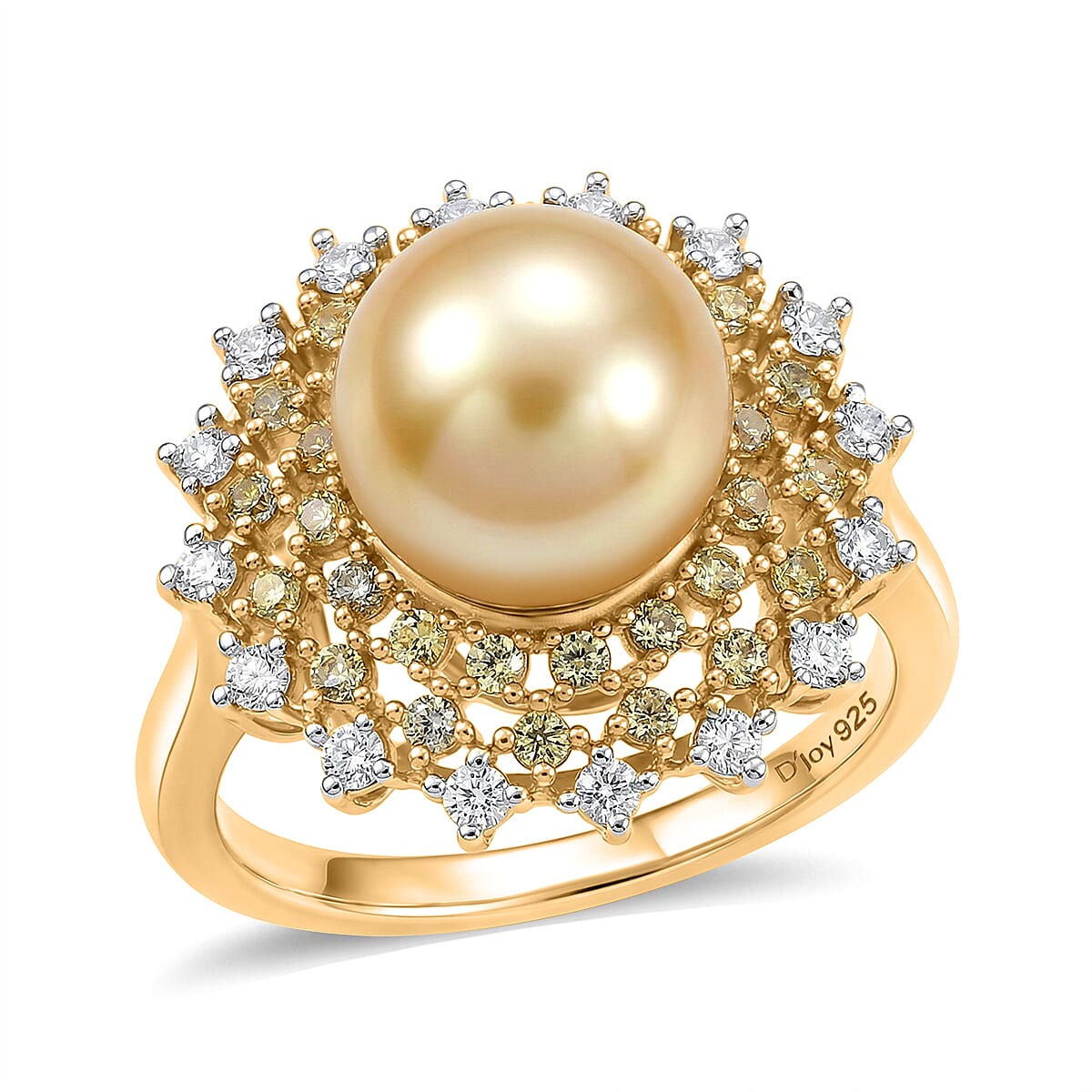
Pearls and gemstones are often worn together, and you see that more and more in current designs. Diamonds are often used alongside pearls. The sharp, high-reflection sparkle of a diamond sits very differently next to the softer glow of a pearl, and that contrast is usually the point.
Since pearls are softer, the way they're set really matters. They shouldn't sit in constant contact with harder stones or rough edges. That's where wear starts to show over time.
So designs often separate them on purpose. A pearl necklace with a gemstone pendant, or earrings where each material has its own space, usually holds up better in the long run.
The comparison between pearls and gemstones isn't really about which is better. It's more about how different they are. Gemstones come from geological processes. They're hard, and they tend to throw back light in a sharp, direct way. They're built under pressure over long stretches of time, and that history shows in how they behave in jewelry.
That's where their brilliance comes from. Pearls come from a living organism. Their surface is softer in appearance, and the way they reflect light comes from layers rather than cuts. It feels more gradual, less intense. When you put them together in a piece of jewelry, they don't compete; they create a great contrast.
When you're choosing between pearls and other gemstones, it mostly comes down to how you live and how often you'll wear the piece.
Pearls ask for a bit more attention. They're softer, so they don't love rough handling or constant friction. But what they give back is a different kind of look. The surface doesn't flash in sharp points of light. It shifts more gently as you move, with layers that seem to change depending on the angle.
Gemstones are built differently. They're harder, so they handle daily wear better. Small knocks or light surface marks usually aren't very noticeable, and the shine tends to hold up without needing much care.
That's part of why they're used so often in everyday jewelry. But it's not really a case of one replacing the other. It depends on your routine, and what you want the piece to feel like when you're wearing it.
FAQs
Q. Are pearls considered gemstones?
A. Yes, pearls are organic gemstones formed inside living mollusks.
Q. How are pearls different from gemstones?
A. Pearls form biologically, while gemstones form through geological processes.
Q. Can pearls be worn every day?
A. Yes, but they need careful handling to avoid damage.
Q. What affects pearl and gemstone pricing?
A. Rarity, size, color, and quality determine price.
Q. Can pearls and gemstones be used together?
A. Yes, but they're often separated in designs to protect pearls.
Q. Are pearls more expensive than gemstones?
A. It depends on quality; high-end pearls can match or exceed some gemstones.


 View Cart