


EMERALD VS. OTHER GREEN GEMSTONES: WHICH IS BEST FOR ENGAGEMENT RINGS?
For decades, bridal jewelry followed a traditional formula—focusing on the 4Cs, maximum brilliance, and a classic diamond solitaire. Today, more couples are choosing engagement rings that reflect their personal style, making colored gemstones increasingly popular. Among them, green gemstones stand out for their association with renewal, growth, and balance. While emeralds remain a well-known choice, they aren't the only option, and durability is an important factor when selecting a ring designed for everyday wear.
OVERVIEW
Understanding Emeralds: The Verdant Standard
To evaluate any green gemstone alternative, we must first understand the benchmark against which they are all measured. To a gemologist, the line is pretty clear. An emerald isn't just any green stone. It's a specific type of beryl. What gives it that green color is tiny amounts of elements like chromium, vanadium, or sometimes iron mixed into the crystal while it forms.
The best emeralds show a strong, rich green. It's deep and clear, with a slight hint of blue in it. When that color starts shifting toward yellow or looks too light, it usually isn't called emerald anymore. It falls under green beryl instead.
When you view an emerald in person, you aren't just looking at color; you are looking at its jardin (the French word for garden). This poetic term describes the complex network of internal inclusions—fissures, microscopic liquid pockets, and tiny crystal growths—indigenous to almost all natural emeralds.
Discover Our Best Sellers for Green Gemstone jewelry
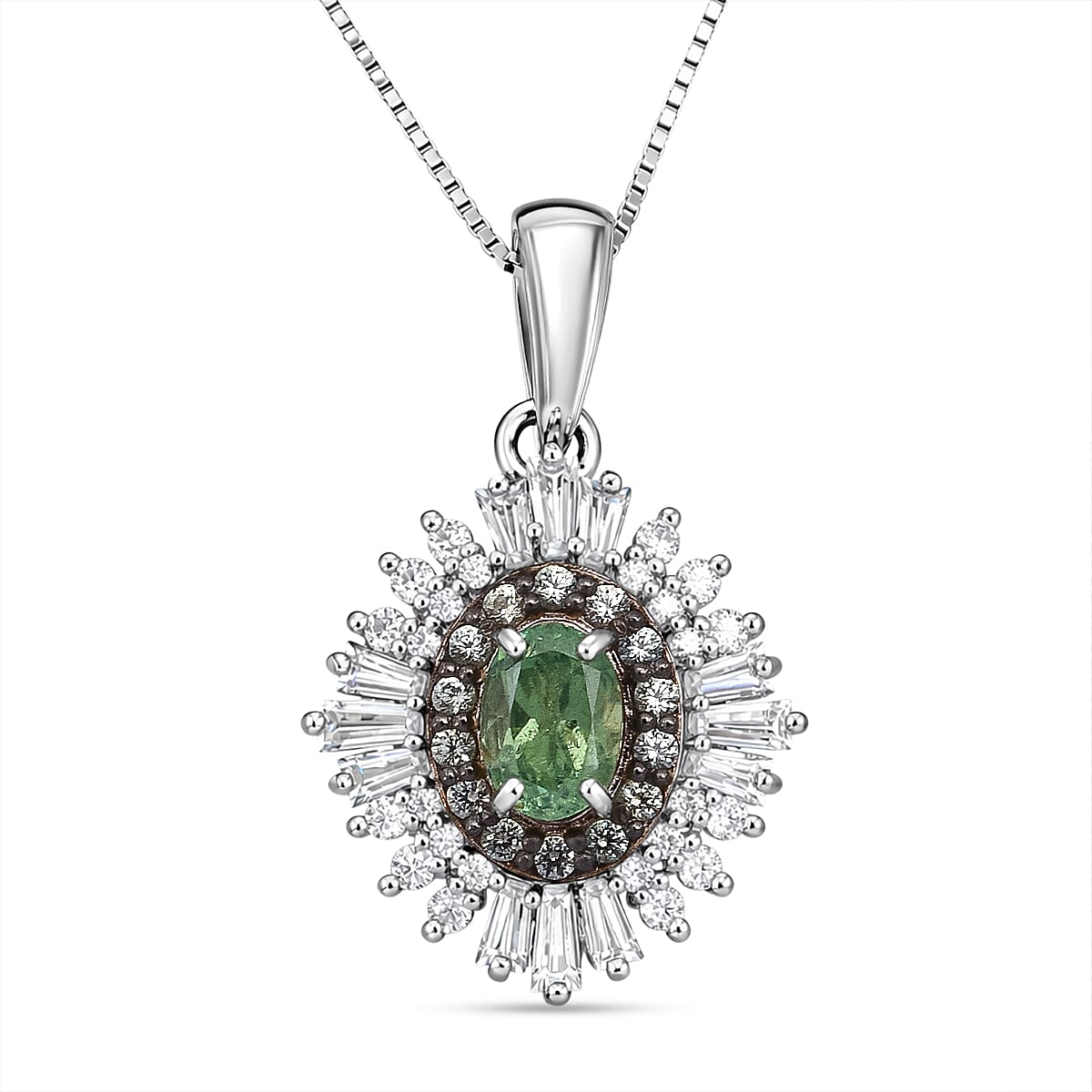
D'Joy Premium Ambanja Demantoid Garnet and Multi Gemstone 1.30 ctw Woodland Spark Halo Pendant Necklace in Rhodium Over Sterling Silver 20 Inches
A striking blend of color and brilliance, this sterling silver pendant necklace showcases a rare Ambanja demantoid garnet framed by green sapphires and sparkling moissanites. The halo-inspired design highlights the gemstone's vibrant yellow-green hue, while rhodium plating enhances durability and shine. Ideal for those who appreciate distinctive gemstone jewelry with contemporary elegance.

D'Joy Hebei Peridot 2.50 ctw 5-Stone Necklace in Sterling Silver 18-20 Inches
Inspired by the symbolism of love, trust, friendship, loyalty, and commitment, this 5-stone peridot necklace brings meaningful design to everyday jewelry. Featuring five olive-green peridots arranged in a sleek bar style, the sterling silver pendant offers a fresh and vibrant look. Its versatile design makes it a thoughtful gift and a timeless addition to any collection.

Luxoro AAA Narsipatnam Alexandrite and Diamond 1.25 ctw Halo Ring in 14K White Gold
This luxurious halo ring centers on a rare AAA Narsipatnam alexandrite, celebrated for its captivating color-changing beauty. Accented by baguette and tapered baguette diamonds, the design creates exceptional sparkle and dimension. Crafted in 14K white gold, it combines rarity, elegance, and timeless sophistication in a statement-worthy piece.

Rhapsody AAAA Zambian Emerald Beaded Necklace Graduated Single Strand 18 Inch in 950 Platinum 60.00 ctw
Featuring an impressive 60 carats of graduated AAAA Zambian emeralds, this beaded necklace captures the rich beauty of one of the world's most prized gemstones. The vivid forest-green emeralds are paired with 950 platinum for a refined and luxurious finish. Its classic silhouette makes it an elegant choice for formal occasions and fine jewelry enthusiasts.

Certified & Appraised Iliana AAA Kagem Zambian Emerald and G-H SI Diamond 2.15 ctw Ring in 18K Yellow Gold
This certified and appraised halo ring showcases a vibrant AAA Kagem Zambian emerald surrounded by brilliant G-H SI diamonds. Set in luxurious 18K yellow gold, the design highlights the emerald's rich green color while enhancing its presence with a sparkling diamond halo. A sophisticated choice for milestone celebrations, engagements, or collectors of fine gemstone jewelry.
COMPARISON
Emerald vs. Other Green Gemstones
If you like the rich green look but don't want to deal with the softness of emerald, there are other stones worth looking at. Some green gemstones hold up better in daily wear. Others give you a different kind of shine or depth, even if the color feels close at first glance.
They don't all wear the same ones once they're on a hand. Some stones stay steady even with regular wear. Their surface doesn't shift much, so they tend to look the same day after day.
So, it's less about picking a single "best" option. It's about what fits into your day. What you like to see, and what you're comfortable maintaining once it becomes something you wear often.
Green Sapphire
Green sapphire belongs to the corundum family, the same group as blue sapphire. The color usually stays on the quieter side. It's not bright or flashy. Most stones sit in olive or mossy green tones, and some go deeper, closer to a forest shade. If you move it around, the look can shift a bit. Not a full change in color, just small differences depending on how the light hits it. What really sets it apart is how tough it is. It's close to diamond on the hardness scale, so it handles daily wear well. Rings especially tend to keep their surface without getting marked up easily over time.
Tsavorite Garnet
Tsavorite was discovered in the late 20th century near the Serengeti.
It's a type of garnet known for its strong, vivid green and unusually clean look. Compared to emerald, it lets more light pass through, so the stone often looks brighter and more lively when it moves.
The green can look strong and vivid, and from a distance, it can resemble a high-quality emerald.
Up close, the differences are easier to see. Tsavorite is usually much clearer, with fewer visible inclusions. Light passes through it more easily, so the stone looks more open and defined instead of slightly obscured inside.
Green Tourmaline (Verdelite)
Tourmaline doesn't stay in one fixed shade for long. Even within a single stone, the green can shift as you move it around. One angle feels darker, then it opens up a little as the light changes.
Most green tourmaline sits in that mossy to deep forest range. Nothing too bright. It has a more natural look, the kind that feels closer to raw crystal than a highly polished surface.
It's usually picked by people who don't want something overly sharp or showy. More something that feels steady, a bit earthy, and easy to wear without thinking too much about it.
Chrome Diopside
Chrome diopside gets its green from the same element found in fine emeralds — chromium. The color is deep and saturated, often leaning into a dark forest green that can look surprisingly rich for the price point. But the trade-off is durability. It's a softer stone, so it can scratch or wear more easily with daily use. Because of that, it usually needs protective settings if it's going to be worn often, especially in rings.
Peridot
Peridot forms deep inside the Earth's mantle. In rare cases, it's even found in meteorites. The color stands apart from emerald-style greens. It usually sits in an olive to lime range, with a soft golden tone running through it.
That mix gives it a lighter, more open look. It's often used in designs that lean vintage or a bit more unusual, where the green doesn't need to feel deep or heavy to stand out.
VALUE
Price and Value Comparison: Green Diamonds vs. The Field
From a performance perspective, green diamonds are the gold standard. Ranking a 10 on the Mohs scale, diamonds are the hardest natural gemstone you'll come across. However, the value proposition is where the path splits drastically:
- Natural Green Diamonds: These are among the rarest geological anomalies on Earth, colored over millions of years by underground radiation. A natural, vividly saturated green diamond can easily command six figures per carat, putting them out of reach for traditional retail buyers.
- Emeralds: High-quality, natural emerald engagement rings with intense saturation and minimal treatment are also rare, commanding a premium price tag, though significantly below that of a natural green diamond.
- Green Sapphires & Tsavorites: These offer the smartest value play. They provide premium beauty and excellent everyday wearability at a fraction of the cost of an emerald, allowing couples to allocate more of their budget toward intricate, custom platinum or gold mountings.
Curation: Unique Green Rings for Weddings
If you want to move away from conventional design paths, green gemstones give you a lot of room to work with. The focus should shift to styling choices that match different style personas.
- The Modernist Toi et Moi: This style pairs two distinct stone shapes side by side, symbolizing two unique lives intersecting. Pair an asymmetrical, elongated pear-cut green tourmaline with a crisp, emerald-cut diamond on an architectural, open-ended gold band.
- The Botanical Cascade: For those drawn to romantic, nature-inspired elements, a mint-green tsavorite garnet set in a low-profile rose gold band woven with delicate, pave-set diamond leaf motifs offers an organic, ethereal charm.
- The Neo-Classical Halo: Instead of a traditional round diamond frame, encircle a rich green sapphire center stone with a sharp, hexagonal halo of baguette diamonds. This graphic approach feels entirely custom, clean, and highly sophisticated.
BUYING GUIDE
Ultimate Buying Considerations for Your Green Stone Ring
Before finalizing your decision on a green bridal piece, it helps to pause and review the practical checklist a bench jeweler uses to evaluate a custom commission. If you are asking yourself, what should I consider when choosing a green stone ring for jewelry? Prioritize these core pillars:
- Lifestyle Match Over Pure Aesthetics: Be honest about how you'll actually wear the ring. If your hands are always busy, you lift weights, or you don't want to keep taking it off at home, emerald may not be the best fit. It can be too fragile for that kind of routine. In that case, a tougher option makes more sense. Green sapphire holds up well to daily impact. A green diamond is even more durable. Both are better suited for constant wear without needing much extra care.
- Treatment and Clarity Disclosure: Nearly all natural emeralds are oiled or treated with resin to fill surface-reaching fractures and improve clarity. This is standard practice, but it must be disclosed. Always ask for documentation from the jeweler that clearly states the level of clarity enhancement.
- The Impact of Metal Choice on Tonal Temperature: The metal you choose changes how the green stone looks. Yellow gold brings out warmer greens. You'll see more olive and grass-like tones, with a softer, slightly vintage feel. Platinum and white gold do the opposite. They create a sharper contrast and make the stone look cooler, often pulling out hints of blue while keeping the edges more defined.
- Setting Security: If your heart is set on an emerald or a softer green stone like chrome diopside, protect your investment through intelligent design. Opt for a full-bezel setting that wraps the stone's vulnerable edges in a protective wall of metal, or select a sturdy, heavy-pronged basket design.
Final Words
Choosing Your Reflection
A green engagement ring isn't just a stand-in for a diamond. It points in a different direction altogether. You might go for an emerald with its natural inclusions still visible. Or a green sapphire if you want something that can handle daily wear a bit more easily. Tsavorite is another option, usually brighter and cleaner in tone.
In the end, choosing a emerald vs green gemstone engagement ring comes down to two simple things. What you actually like looking at. And what fits into your day without needing much thought or care every time you wear it.
FAQs
Q. What is the main difference between emerald and other green gemstones?
A. Emerald is a beryl known for visible inclusions and softer durability, while many green alternatives are cleaner and tougher for daily wear.
Q. Which green gemstone is best for everyday use?
A. Green sapphire and green diamond are the most durable options for constant wear.
Q. Are emerald engagement rings fragile?
A. Yes. Most emeralds contain internal fractures and often need protective settings and careful handling.
Q. How does tsavorite differ from emerald?
A. Tsavorite is usually clearer, brighter, and more resistant to wear than emerald.
Q. Does the metal change how a green stone looks?
A. Yes. Yellow gold warms the green; white gold and platinum make it look cooler and sharper.
Q. Which green gemstones offer the best value?
A. Green sapphire, peridot, and green tourmaline typically offer strong visual appeal at more accessible price points.


 View Cart